
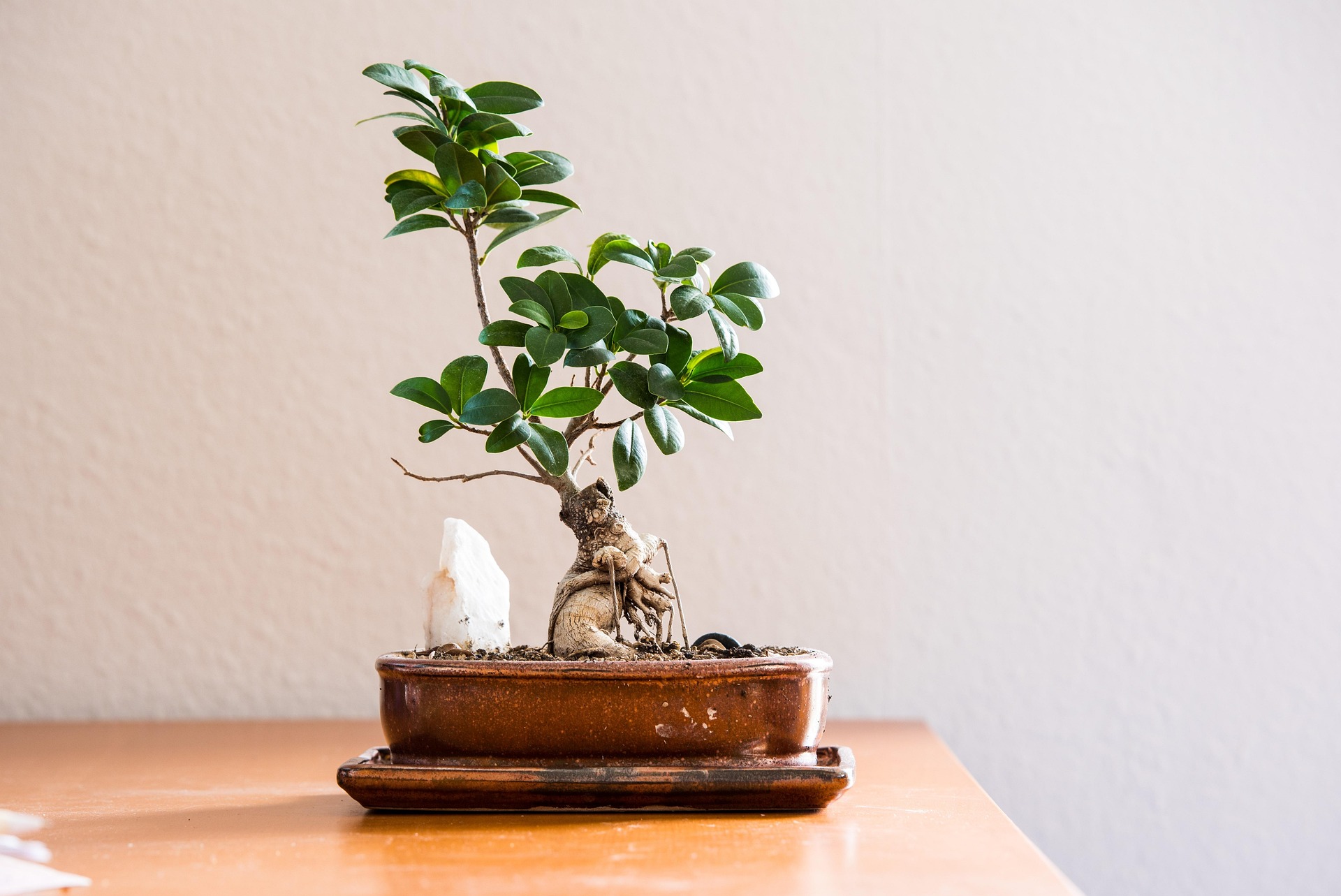
Discover how to create and take care of a bonsai with simple steps.
What are bonsai?
The Cambridge Dictionary define bonsai as “a small decorative evergreen shrub or tree grown in a pot, wich has been prevented from growing to its usual size by various methods“.


Curiosity about bonsai
- Origins: Bonsai originated from the Chinese practice of Penjing over 1,000 years ago. The art was later refined and popularized in Japan (Jain, 2025, p.1).
- Longevity: Certain Bonsai trees are hundreds of years old and passed down through generations. One famous example is a tree that survived the Hiroshima atomic bombing and is still alive today in the U.S. Read the article here.
- Styles: There are many Bonsai styles. Classic styles include formal upright, informal upright, slanting, cascade, and semicascade each representing different natural scenes (Relf & Olsen, 2026).
- Health benefits: Bonsai activity can improve wellbeing by helping people relax, stay present, and deal with stress and emotions (Pack, 2023).


How to care for bonsai
As a beginner, you might want to grow a bonsai but don’t feel confident starting from a seed. That’s completely okay, there are many places where you can buy a bonsai already grown. I personally recommend avoiding online plant shops whenever possible.
👉Let me know in the comments which shop you would suggest!
Here are some tips on how to take care of your bonsai. Be sure to learn more about the specific species you have at home.
1. Placement (sun & humidity)
Indoor Bonsai:
- Place near a south-facing window for maximum light ☀️☀️☀️
- They need constant temperature throughout the day
- Most indoor Bonsai are (sub)tropical and prefer high humidity, place them on a humidity tray
Outdoor Bonsai:
- The natural seasonal cycle is essential for tree health
- Place in a bright, well-lit spot
- Provide afternoon shade in very hot summers
- Protect in winter if necessary, depending on the species
Source: Bonsai Empire
2. Water💧
- Water your Bonsai when the soil is slightly dry
- Check soil moisture about 1 cm deep with your finger
- Avoid strict watering schedules; observe each tree individually
- Do not let the tree dry out completely, but don’t overwater either
- Use a proper soil mix (e.g., akadama, pumice, lava rock)
How to water:
- Use a watering can with a fine nozzle to avoid washing away soil
- For indoor Bonsai, you can water them in a sink and then place them back
Source: Bonsai Empire
3. Fertilising ✨🌱
Basic components:
- Nitrogen: promotes leaf and stem growth
- Phosphorus: supports roots, flowers, and fruits
- Potassium: improves overall plant health
- Fertilizers may also include micronutrients (iron, zinc, etc.)
🕑When to fertilize:
- Fertilize during the entire growing season (spring to mid-fall)
- Indoor Bonsai: can be fertilize year-round
- Mature trees need less frequent feeding
Application:
- Can use liquid or solid, organic or synthetic fertilizers
- Follow product instructions carefully: adjust amount based on tree stage and needs
- Ensure well-draining soil to avoid salt buildup
- Avoid over-fertilizing, as it can harm the tree
Source: Bonsai Empire
4. Repotting✂️🌿
- Why: Regular pruning is required to maintain shape and good health.
- When: Repot in early spring, because the tree is still dormant.
- How often: Quick-growing trees should be repotted about every two years. Older trees usually require repotting every three to five years.
Source: Bonsai Empire
Simplified repotting guide:
- Remove the tree carefully from the pot
- Remove old soil gently with a chopstick (protect roots; for pines, keep part of root mass)
- Prune long roots (max 30%)
- Prepare the “new” pot (with drainage mesh and a eventually a wire)
- Add a drainage layer (coarse soil like lava rock or akadama)
- Add a layer of Bonsai soil
- Place the tree (and secure it with the wire)
- Add soil around the roots (use a chopstick to remove air pockets)
- Water thoroughly
- Monitor recovery after repotting
Source: Bonsai Empire


Let’s meet some real stories
The following paragraphs share the journeys of Sir Ficus and Lady Wistery, two plants close to me, each on their path toward becoming bonsai.
Both have faced challenges along the way, yet their stories offer simple, beginner-friendly lessons, showing that even with little experience, patience and care can lead to meaningful growth.
Looking for more indoor plant inspiration? Don’t miss my article: 9 indoor plants to love at home.
The story of Sir Ficus
Sir Ficus has been part of his family since November 2015. Over the years, his family learned that this delicate tree dislikes sudden changes, no drafts, no moving around, just a stable, bright spot near a window that stays closed.
Years passed gently, until 2020 brought an unexpected change. His family had to move, and Sir Ficus struggled deeply, losing nearly all his leaves and lower branches. For a while, it seemed like the end. But his family didn’t give up…
With a simple, consistent routine (weekly soaking baths, careful placement, and refreshing the soil twice a year) they slowly nurtured him back to life.
Nearly a decade later, Sir Ficus regrew his lower branches, fuller and greener than before. Today, he stands as a beautiful tree, a reminder that even the most fragile plants (and beginner growers) can thrive with time, consistency, and a little faith.
Before (2015)

Today

The story of Lady Wistery
Lady Wistery is a three years old wisteria, not yet a bonsai, but aiming to be. She started as a seed and, carefully nurtured by her family, she has grown branch by branch.
A few months ago, however, her journey nearly came to an end. She fell, her pot shattered, and her main trunk snapped in two. It seemed like she was lost. But just a week later, new life appeared. Today, she is greener and stronger than ever.
With the arrival of milder temperatures, she’s back on the balcony.
Her story is simple: resilience can surprise us, and when we rise again, we often come back brighter than before.

Bibliography:
- Bonsai Empire. (n.d.). Bonsai tree care. Retrieved April 14, 2026, from https://www.bonsaiempire.com/basics/bonsai-care/
- Cambridge Dictionary (April 4, 2026) Bonsai. https://dictionary.cambridge.org/dictionary/english-german/bonsai
- Jain M. (2025). Bonsai: The Science and Art of Miniature Tree Culture – A Review. International Journal of Engineering Research & Technology. 14(12). https://doi.org/10.5281/zenodo.18074248
- Pack S. (2023) Bonsai: “a life in balance”. The therapeutic benefits of growing bonsai trees. Journal of Therapeutic Horticulture. University of Hertfordshire. 33 (1). pp. 1-18. https://researchprofiles.herts.ac.uk/en/publications/bonsai-a-life-in-balance-the-therapeutic-benefits-of-growing-bons/
- Relf D. & Olsen E. (2026). The art of bonsai. Virginia Cooperative Extension, Virginia Tech. https://www.pubs.ext.vt.edu/426/426-601/426-601.html


Leave a Reply